
Review · OMAN
Via Ferrata And Zip Line
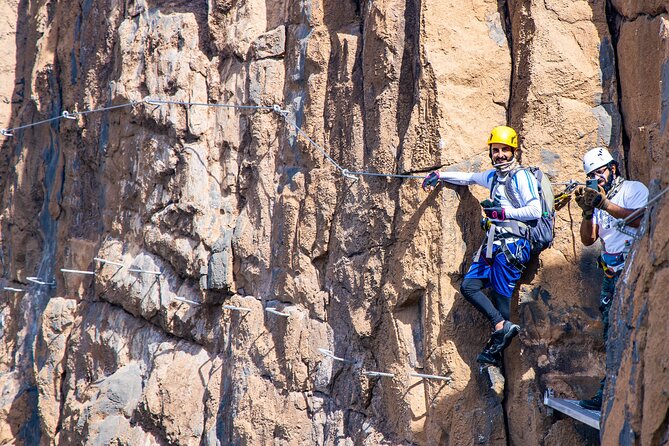
Jebel Akhdar’s 180-meter Via Ferrata gives you a close-up look at Oman’s mountain country, then sends you back by zipline. You move across an iron bridge, use steel ropes and fixed steps, and reach points as high as 45 meters above the ground. The route is short enough to fit neatly into a day in the mountains, but it still delivers a proper adrenaline rush.
I like two things here: the steady learning curve and the guides’ calm attention to safety. Names that come up in the guiding team include Maher, Khalifa, Said, Ali, and Mehmood. A solo participant can still go ahead without a larger group, and small family groups may receive several guides.
The main consideration is height. Even people with climbing experience have found the small metal footholds thrilling, and some sections require arm strength while you hold the cable and pull yourself along. If heights unsettle you, this may feel harder than the phrase adventure for everyone suggests.
Key Points Before You Book
- A three-part mountain route: The course includes an iron bridge, steel rope sections, and a stairway.
- A 45-meter-high finish: The route is not a flat walk with a token climb. You will work above the valley.
- Zipline return: At the end of the Via Ferrata, you return by zipline rather than retracing the route.
- Beginner-friendly, but not effortless: You need moderate physical fitness, arm strength, and comfort with heights.
- Strong guide support: The activity includes an instructor, safety equipment, a helmet, and a first aider.
- Flexible transport options: The meeting point is in Jebel Akhdar, with paid transport available from Nizwa and Muscat.
What the Jebel Akhdar Route Feels Like
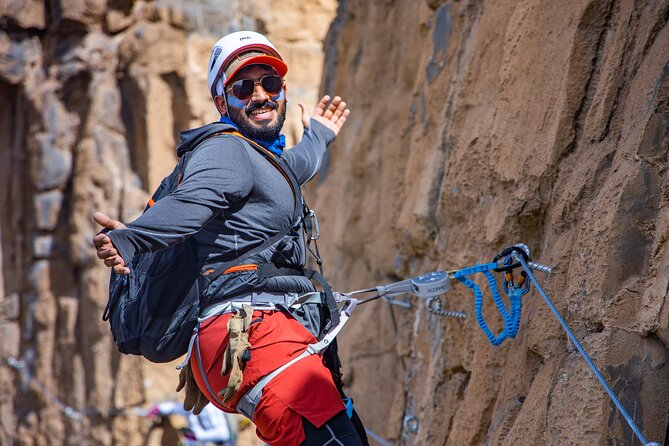
Via Ferrata means iron path. You wear a harness connected to a fixed steel cable, then move along a route attached to the rock. The cable and leash are there to protect you as you climb, but they do not remove the need to place your feet carefully or use your arms.
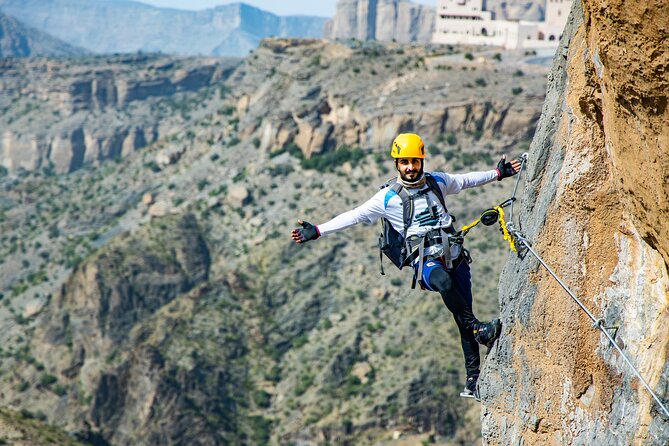
This route is about 180 meters long and reaches up to 45 meters in height. That combination matters. The distance is manageable, but the exposure gives the experience its bite. You are not spending hours on a huge climb, yet the height is enough to make each metal foothold feel important.
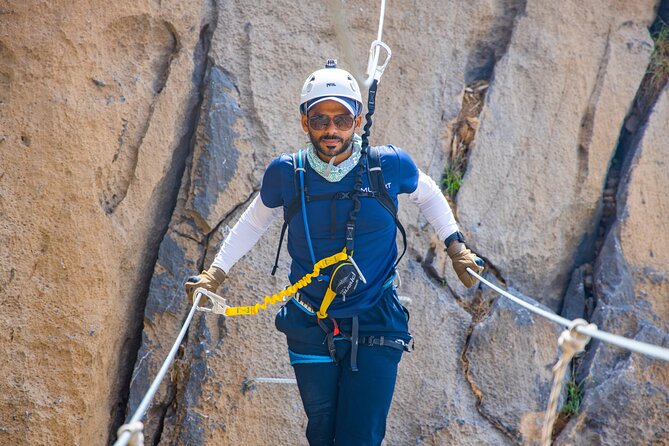
The activity is split into three parts: an iron bridge, steel rope sections, and a stairway. Each section changes the rhythm. The bridge tests your balance. The rope sections ask you to move while staying clipped to the cable. The stairway gives you a more familiar form of climbing, though the height can still make it feel far from an ordinary staircase.
You should allow about two hours for the full activity. Some participants finish the easy-medium route in roughly one to two hours, and the experience can feel shorter once you get moving. The exact pace depends on your group, your confidence, and how often you pause to manage the height or take photographs.
More Via Ferrata Routes in the world:
- Banff: Mount Norquay 2.5 or 4-Hour Guided Via Ferrata Climb
★ 4.9 · 305 reviews - Sant Feliu de Guixols: Climb Via Ferrata Cala del Molí
★ 5.0 · 253 reviews - Via Ferrata / Rappel Adventure in East Zion
★ 5.0 · 224 reviews
The Iron Bridge Starts the Nerve Test
The iron bridge is a useful opening section because it quickly shows you what the route demands. You are attached to the safety system, but you still need to walk across metal rather than solid ground. The combination of open views and a narrow crossing can make this feel more serious than the equipment briefing suggests.
This is also where a guide’s manner matters. The guides are there to explain how to use the harness and cable, then help you maintain a sensible pace. Ali, Maher, Khalifa, Said, and Mehmood are among the guides praised for being reassuring and attentive. You should still listen closely, especially if this is your first Via Ferrata.
The bridge is not necessarily the hardest part, but it sets the tone. If you are nervous, look at the next handhold rather than trying to take in the entire drop at once. The route is designed around fixed safety points, but your comfort still depends on how well you handle exposure.
Steel Ropes and Small Footholds
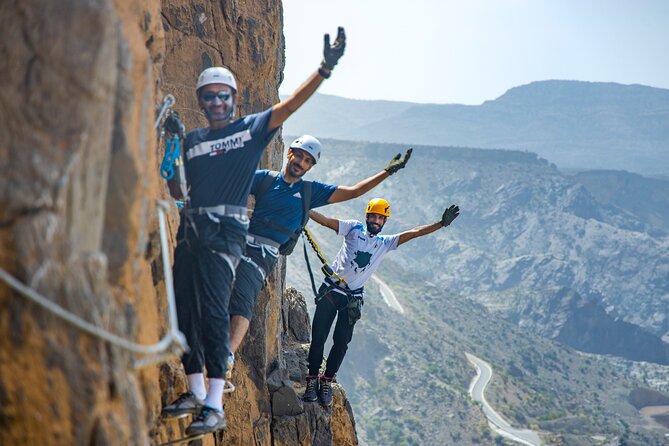
The steel rope section is where the activity begins to feel like climbing. You progress along the rock while connected to the cable. The metal footholds can be small, and some sections may require you to hold the cable and pull yourself forward.
That detail is important for anyone comparing this with a simple zipline or a sightseeing platform. The zipline is only part of the experience. Most of your time is spent making controlled movements on the cliff, so moderate fitness is a real requirement, not just a box checked during booking.
You do not need to arrive as a rock climber. The route has been used by beginners, families, and people trying Via Ferrata for the first time. Still, you should be comfortable standing and moving at height, and you need enough arm strength to support yourself when the footholds become awkward.
The fixed route gives you a clear task. Clip into the safety system, move to the next point, and keep your body close to the rock where possible. A guide can help with the process, but you remain responsible for moving carefully and following instructions.
The Stairway Gives the Route a Different Rhythm
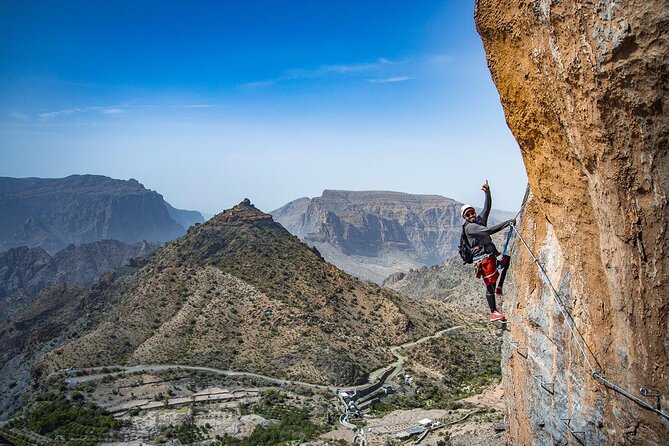
The stairway section replaces some of the more technical movement with steps. That can feel easier on the hands, but it does not remove the exposure. You are still climbing above the mountain, and the views remain part of the challenge.
This is the point where you may appreciate the setting most. Jebel Akhdar is known for its dramatic mountain terrain, and the route places you in it rather than viewing it from a road or hotel terrace. The cliffs and open mountain views are the backdrop throughout the climb, not a short photo stop at the end.
Photography is possible, but keep it secondary. Your hands and attention are needed for the route. If you bring a phone, use it only when the guide confirms that you are in a safe place to pause. The activity is more rewarding when you stay focused instead of trying to record every step.
More Zip Lines in the world:
- Extreme Adventure, Wildest Bridge, ATV & Ziplines
★ 5.0 · 3,179 reviews - Tree Limin’ Extreme Zipline
★ 5.0 · 1,713 reviews - Full-Day Zipline and Waterfall Rappelling Adventure Near San Juan
★ 5.0 · 889 reviews - Extreme Horses Adventure with ATV, Ziplines & Cenote
★ 5.0 · 590 reviews
The Zipline Is the Best Finish
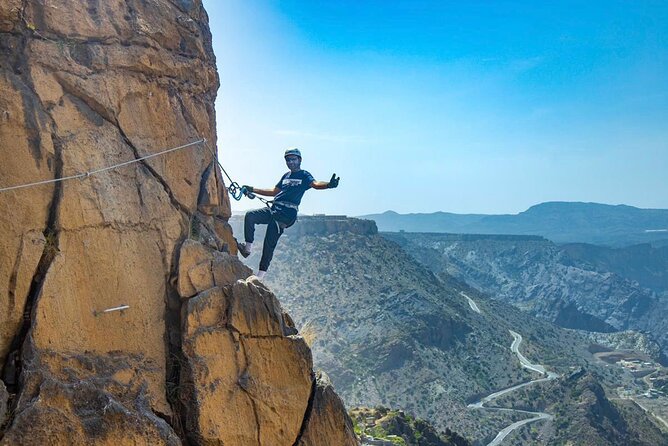
At the end of the Via Ferrata, you return by zipline. This changes the mood immediately. The climb asks for concentration and steady movement, while the zipline gives you a quick, clean payoff.
For many people, this is the moment that makes the activity feel complete. You have worked your way across the route, dealt with the height, and then get to travel back through the air. The zipline is exciting without adding another technical climb, though anyone very uneasy about height should understand that the final section does not bring you back to ground level in the usual way.
The return also saves you from repeating the course. That matters in a two-hour activity. You get both the physical challenge of the Via Ferrata and the faster thrill of the zipline without spending the rest of the session retracing the same steps.
Guides, Safety Gear, and Group Size
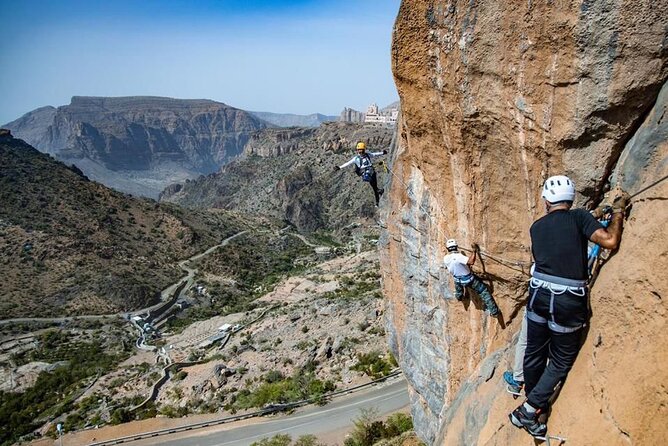
The package includes safety equipment, a helmet, a Via Ferrata instructor, and a first aider. That is the right basic setup for an activity where you are attached to rock and cable above the ground.
The maximum group size is 20 people. That is not an especially tiny limit, so ask about the expected group when you book if personal attention is important to you. Small groups may receive several guides, which can make a real difference for families or first-time climbers.
The guiding style appears to be one of the strongest parts of the activity. Guides have helped nervous participants settle into the route, and solo participants have not been turned away simply because they had no group. The named guides, including Maher, Khalifa, Said, Ali, and Mehmood, are associated with friendly instruction and careful handling of safety.
That said, the equipment is not a substitute for judgment. You should follow the guide’s instructions, move at a controlled pace, and be honest about your comfort level. The route may be suitable for beginners, but it is not passive sightseeing.
Is $150 a Fair Price?
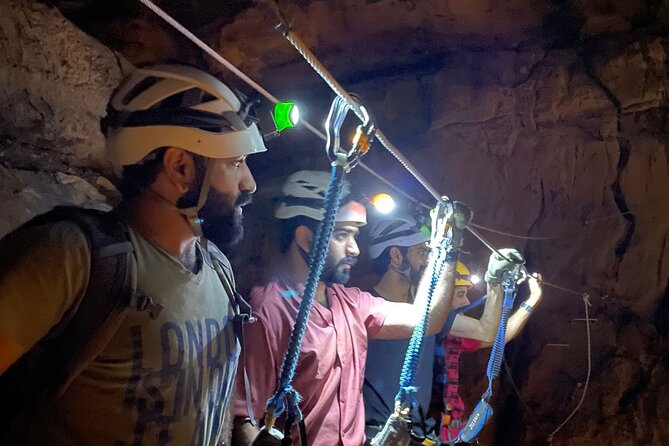
At $150 per person, this is a premium short activity. You are paying for an instructor, safety equipment, helmet, first aider, route management, and a combined climb-and-zipline experience in Jebel Akhdar.
The value depends on what you want from a mountain visit. If you only want views, a road excursion or lookout will cost less and require less effort. If you want a guided activity that puts you above the cliffs and gives you a memorable physical challenge, the price is easier to justify.
Transport from Nizwa and Muscat is available for an extra charge. Since the meeting point is in Jebel Akhdar, check your transport plan before booking. The activity itself ends back at the meeting point, which makes it easier to combine with your own day in the mountains if you already have a vehicle.
The experience is often booked about 18 days ahead. That suggests you should not leave it until the last moment, especially if your Oman schedule is fixed. Opening hours are listed daily from 8:00 AM to 5:30 PM, for the stated operating period through June 17, 2026.
Who Will Enjoy This Most?
I would recommend this for an active first-timer, a couple looking for a shared challenge, or a family with older children who meet the fitness requirements. It also works well for solo visitors because the activity can go ahead without you bringing a group.
You will probably enjoy it if you like:
- Heights and open mountain views
- Short, active excursions rather than long sightseeing stops
- A controlled introduction to Via Ferrata
- A zipline finish after a physical climb
- Guides who offer close help and reassurance
You may want to skip it if you have a strong fear of heights, limited arm strength, or difficulty with moderate physical activity. One participant with rock-climbing experience still found the small metal brackets surprisingly scary, so experience on a climbing wall does not guarantee that this will feel easy.
The route is described as easy-medium by some participants, but that label should not be read as gentle. The technical movements may be straightforward, yet the height adds pressure. In practical terms, the climbing is accessible, but the exposure can be advanced for your nerves.
Booking, Weather, and Cancellation Details
Confirmation is provided at booking, and the ticket is mobile, so you can keep the reservation on your phone. Gratuities are not included.
The activity requires suitable weather. If poor conditions force a cancellation, you can choose another date or receive a full refund. The same choice applies if the minimum number of participants is not reached.
You can cancel for a full refund up to 24 hours before the start time. Cancellations made within 24 hours are not refunded, and changes inside that period are not accepted. The cutoff uses local time in Oman, so keep that in mind when adjusting a tightly planned itinerary.
Should You Book the Via Ferrata and Zipline?
Book it if you want more than a mountain view and you can handle height, exposed steps, and moderate physical effort. The route is short, well supported with safety equipment, and varied enough to feel like a real adventure rather than a single zipline ride.
I would be cautious if your fear of heights is severe or if you expect a relaxed family outing. The guides can help you manage nerves, but they cannot make a 45-meter cliff feel like level ground.
For the right person, this is one of the more memorable ways to experience Jebel Akhdar. You climb through three distinct sections, see Oman from an unusual position, and finish by flying back to the meeting point. That mix of effort, scenery, and speed is what makes the $150 price easier to defend.
FAQ
Where does the Via Ferrata and zipline activity start?
The activity starts at Jebel Akhdar in Oman and ends back at the meeting point.
How long does the experience last?
The activity lasts approximately two hours. The easy-medium route may take between one and two hours, depending on the pace of the group.
How high and how long is the Via Ferrata?
The Via Ferrata is about 180 meters long and reaches heights of up to 45 meters.
What sections are included in the climbing route?
The route is divided into three parts: an iron bridge, steel rope sections, and a stairway. The activity finishes with a zipline return.
Is transport from Nizwa or Muscat included?
Transport from Nizwa and Muscat can be arranged for an extra charge. It is not included in the listed activity price.
What happens if bad weather cancels the activity?
You can choose another date or receive a full refund if poor weather causes the activity to be canceled. You can also receive a full refund if you cancel at least 24 hours before the start time.
Fresh thrills added around the world
- Southern California Extreme UTV Tour (19-Mile Tour)★ 5.0 · 19 reviews
- Rappelling Adventure in Joshua Tree National Park (6 Hours)★ 5.0 · 2 reviews
- Mallorca Coasteering Adventure★ 3.0 · 2 reviews
- Private Climbing and Rappelling Experience in Oaxaca★ 5.0 · 6 reviews
- Adrenalin Junkie Tour – 60 mins (min 2)★ 5.0 · 19 reviews
- Rappelling Adventure in Joshua Tree National Park (4 Hours)★ 5.0 · 12 reviews
- Canyoning Adventure in Hidden Mountain Rapids near Geilo★ 4.5 · 16 reviews
- High Adrenaline Rafting in Dagali near Geilo in Norway★ 5.0 · 17 reviews
Via Ferrata Climbing, side by side
Banff: Mount Norquay 2.5 or 4-Hour Guided Via Ferrata Climb
Read our review →
Sant Feliu de Guixols: Climb Via Ferrata Cala del Molí
Read our review →
Small-Group Guided Via Ferrata Climbing with Banff’s Best Views
Read our review →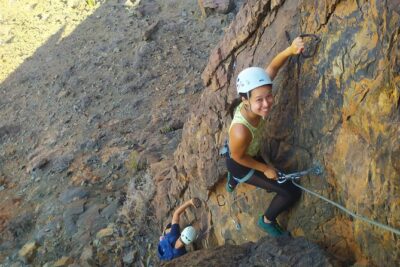
Via Ferrata in Gran Canaria. Vertical adventure park. Small groups
Read our review →Lists this trip sits in